Building a healthcare company is one thing. Building one that solves a problem people actually need to fix is something else entirely. That is what NSF SBIR I-Corps helped us do. At Hidalga Technologies, we started with a strong belief that oncology clinics carry too much administrative burden, especially around prior authorization, and that burden […]
Building a healthcare company is one thing. Building one that solves a problem people actually need to fix is something else entirely.
That is what NSF SBIR I-Corps helped us do.
At Hidalga Technologies, we started with a strong belief that oncology clinics carry too much administrative burden, especially around prior authorization, and that burden is slowing care, straining staff, and creating unnecessary financial friction. I-Corps gave us sharper market clarity, better commercial discipline, and a much deeper understanding of where the pain is most acute and what it will take to earn adoption.
We did not just validate the problem, we refined the market
Before I-Corps, we knew prior authorization was painful. After I-Corps, we understood much more precisely who feels that pain most, how it shows up in daily operations, and where our solution could create immediate value. From 140 new interviews during the 7 week timeframe, our customer discovery work consistently pulled us toward community oncology, especially independent and resource-constrained practices.
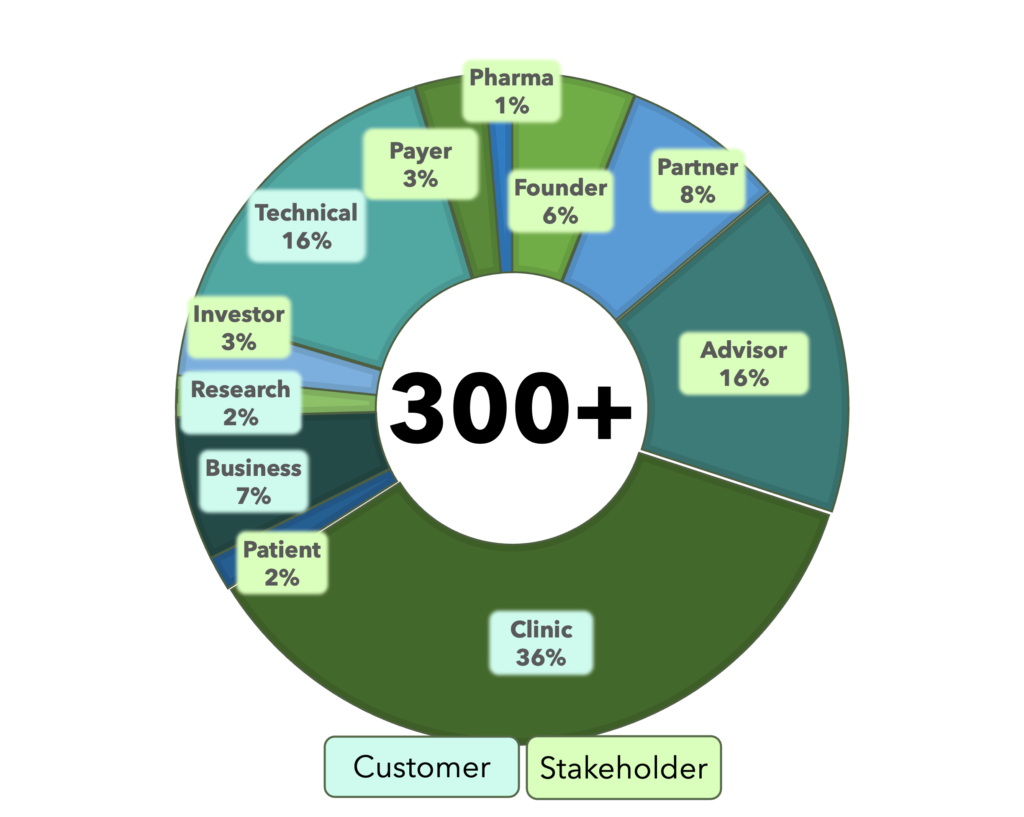
Through structured outreach, we focused on the people closest to the operational problem: practice administrators, revenue cycle leaders, pharmacists, innovation-minded clinic operators, and others responsible for keeping care moving despite payer complexity and staffing pressure. That focus helped us see that this is not just an abstract workflow issue. It is a business-critical problem inside real clinics.
We learned that prior authorization is not just paperwork
One of the most important outcomes from I-Corps was realizing that prior authorization is not merely an annoying administrative step. In oncology, it sits at the intersection of revenue cycle performance, documentation quality, staff workload, and treatment timing.
Across our discovery process, the same themes appeared again and again: avoidable denials, repeated rework, payer variation, peer-to-peers, delayed submissions, and downstream A/R impact. These were not edge cases. They were recurring operational realities. That forced us to sharpen our value proposition. The market did not want generic automation. Customers wanted fewer avoidable denials, faster submissions, less rework, and less burden on already stretched teams.
⛔ Prior auth is severely broken
💰Clinics think in revenue, not workflow
That distinction matters. A clinic is not buying software because it is “AI-enabled.” A clinic is buying relief from expensive operational friction.
We got clearer on where hidalga fits
I-Corps changed how we think about product design.
We came away with much stronger conviction that the right entry point is not broad workflow automation. It is solving the specific moments where oncology teams lose time, lose visibility, or lose reimbursement confidence. In our case, that means chart preparation, documentation readiness, payer-specific packet assembly, and submission readiness, the operational steps that directly influence whether a prior authorization moves forward cleanly or comes back as more work.
🔌 Interoperability is an execution problem
📋 Payers and providers are misaligned
That was a major shift for us. It pushed us to position Hidalga less as a general automation layer and more as workflow intelligence built specifically for oncology operations.
We learned that ROI has to be obvious
Another lesson from I-Corps was straightforward but important: community oncology practices do not have the time or margin to experiment with vague value.
🏥 Pilot metrics that matter
The leaders we spoke with care deeply about measurable outcomes, denial rates, days to pay, documentation quality, and the real staffing cost of inefficiency. In smaller practices especially, every extra hour of rework carries consequences because the same team is often wearing multiple hats. The operational drag is real, and so is the financial impact.
That changed how we think about pilots. We are not approaching pilots as light product demos. We are approaching them as measurable operational improvement efforts. The outcomes that matter are clear: submission cycle time, avoidable denials, peer-to-peer volume, staff time, and A/R aging. In other words, success has to be legible both to the people doing the work and to the people responsible for clinic performance.
We saw the bigger ecosystem, but also the right place to start
Customer discovery expanded our view of the broader oncology ecosystem. We saw how prior authorization friction connects to adjacent issues like biomarker documentation, radiopharmaceutical workflows, pharmacy-led coordination, and access to more complex therapies. We identified partnership and follow-up opportunities across community oncology networks, operations leaders, pharmacy stakeholders, pharmaceutical sponsors, and innovation-oriented practices.
That gave us two important insights at once.
First, the long-term opportunity is bigger than one workflow.
Second, the right way to enter this market is still through a narrow, urgent, high-friction problem with a clear operational and financial return.
That discipline is valuable. It keeps us honest.
The biggest shift was not technical, it was commercial
If I had to summarize the biggest impact of NSF SBIR I-Corps in one sentence, it would be this:
It helped us move from having a strong idea to building a stronger company.
We now have a tighter beachhead, better language for the problem, a more practical go-to-market approach, and a clearer understanding of what customers need before they will trust and adopt a solution like Hidalga. We also have stronger conviction that community oncology is the right place to start, especially where practices are being asked to deliver increasingly complex care under rising reimbursement pressure and limited administrative capacity.
That is what I-Corps is supposed to do. It is not there to confirm your assumptions. It is there to test them, stress them, and force you to build from evidence.
For us, that process made hidalga better.
And more importantly, it made our path forward clearer.
Where we go from here
We are continuing to build with the lessons from I-Corps in mind: stay close to the workflow, stay grounded in measurable value, and keep listening to the people doing the work every day.
If you lead operations, revenue cycle, pharmacy, or administrative workflow in oncology and this problem sounds familiar, we would love to hear from you. We are actively building with real-world clinic feedback and continuing to shape Hidalga around the operational realities that matter most.
The best products in healthcare are not built in isolation. They are built in partnership with the people who live the problem.
Authorship & Copyright
Joshua Upshaw, PhD
Co-Founder, CEO, Principal Investigator | Hidalga Technologies, Inc.
This article is published by Hidalga Technologies, Inc., an Arkansas based healthcare science and technology company building intelligent, clinically aligned workflow optimization systems for specialty medical practices.
© 2026 Hidalga Technologies, Inc. All rights reserved.
Reproduction or redistribution of this content without written permission is prohibited. For reprint or citation inquiries, contact@hidalgatech.com.

You must be logged in to post a comment.